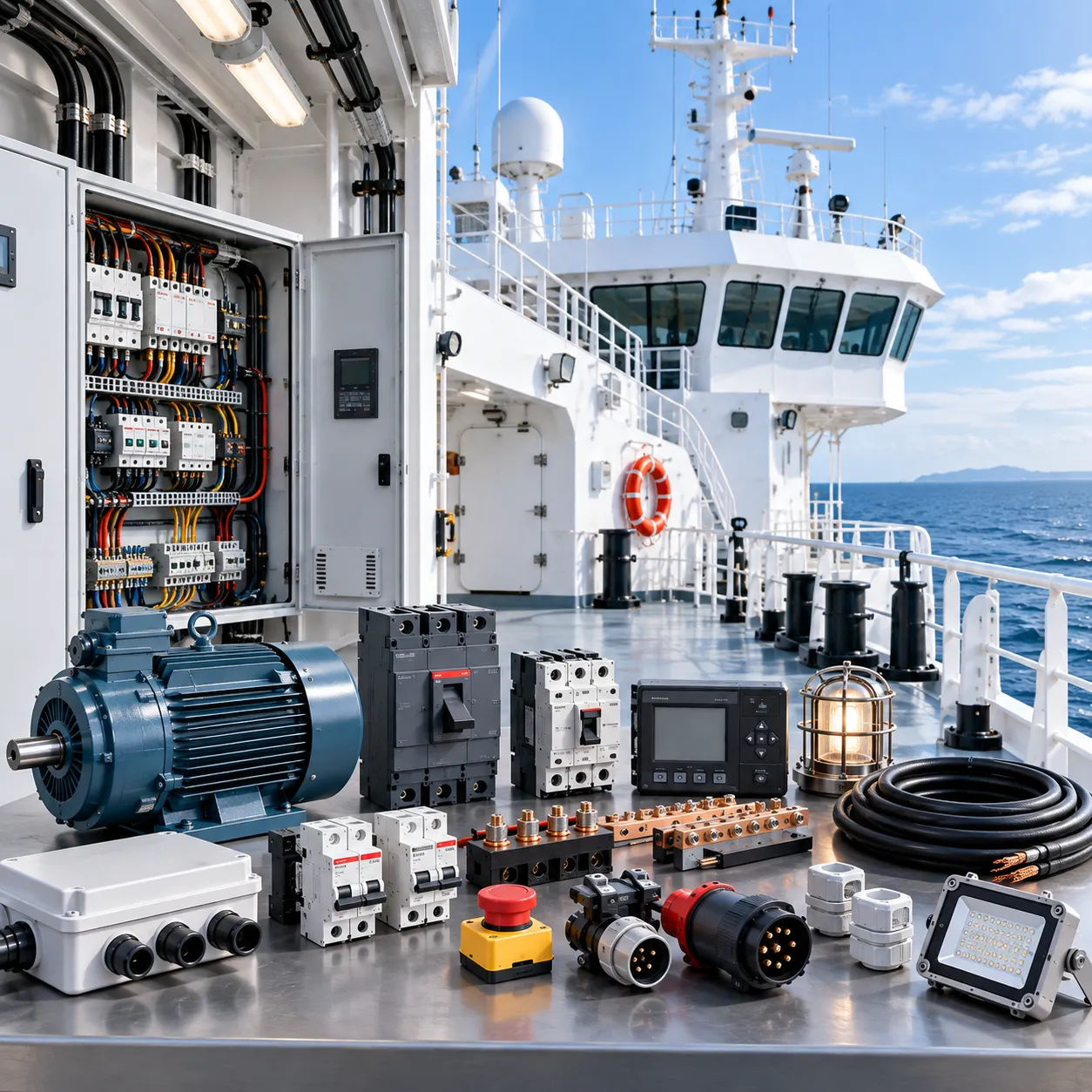


Out on the water, electrical failure isn't just an inconvenience—it’s a serious safety risk.
Whether you’re doing a complete refit or replacing a single breaker, finding reliable sources for marine electrical supplies can mean the difference between smooth sailing and being stranded offshore.
To save you the guesswork, I’ve tracked down and vetted the top sources for marine electrical supplies trusted by seasoned boaters and industry pros alike.
Let's get your vessel powered up the right way.
What Makes a Marine Electrical Supplier Reliable?
Marine-Grade Product Quality
A trustworthy supplier provides components built specifically to survive harsh marine conditions. Standard commercial hardware quickly degrades when exposed to moisture and motion.
-
- Corrosion & Saltwater Resistance: Components utilize tinned copper conductors, marine-grade stainless steel hardware, and nickel-plated brass terminals to prevent galvanic corrosion.
- UV and Temperature Stability: Wiring insulation and switch housings feature specialized UV-stabilized polymers that resist cracking and hardening under direct sunlight.
- Vibration and Impact Resistance: Heavy-duty terminal blocks, heat-shrink connections, and potted electronics withstand continuous engine vibration and rough wave impacts.
Certifications and Compliance Standards
Legitimate marine electrical suppliers rigorously test and certify their inventory to meet international maritime safety codes:
-
- ABYC (American Boat and Yacht Council): Ensures components adhere to strict North American recreational boating electrical standards.
- UL 1426 & UL 1500: Confirms marine-grade boat cable safety and ignition protection for gasoline-powered vessel engine rooms.
- IEC & CE Standards: Verifies electrical safety and electromagnetic compatibility across international markets.
Technical Support and Product Knowledge
Reliable suppliers do more than ship boxes; we act as technical partners. Sourcing high-amperage DC systems or AC shore power units requires precise engineering support:
-
- Accurate Wire Sizing: Clear guidance on calculating voltage drop across extended wire runs.
- Load Calculations: Assistance in matching battery bank capacities, inverter loads, and circuit breaker ratings.
- Complete Datasheets: Readily accessible wiring diagrams, dimensional drawings, and installation guides.
Inventory Breadth and Product Availability
System repairs and vessel refits require a comprehensive component ecosystem. A dependable supplier maintains deep, consistent stock across critical product categories:
-
- Tinned Marine Wiring and Battery Cables: Complete selections of multi-conductor and primary marine wire.
- Circuit Protection: Ignition-protected circuit breakers, marine fuses, and distribution panels.
- Power Management: Marine battery chargers, solar charge controllers, busbars, and isolators.
Warranty, After-Sales Service, and Return Policy
Marine projects operate on strict launch and maintenance schedules. Reliable suppliers stand behind their equipment with clear terms:
-
- Hassle-Free Warranties: Multi-year coverage backing manufacturing integrity in saltwater environments.
- Rapid Replacement Dispatch: Fast-track processing for mission-critical parts to prevent extended vessel downtime.
- Clear Return Policies: Transparent guidelines on overstocked lengths of wire, specialized connectors, and panel accessories.
Core Reliability Evaluation Matrix
| Evaluation Criteria | Standard Industrial Supplier | Reliable Marine Electrical Supplier |
|---|---|---|
| Conductor Material | Bare copper (prone to black oxidation) | Fully tinned oxygen-free copper |
| Safety Certifications | Basic commercial ratings (UL general) | ABYC, UL 1426, UL 1500, CE Marine |
| Ignition Protection | Rarely specified | Certified ignition-protected where required |
| Insulation Jacket | Standard PVC (cracks under UV/fuel exposure) | Oil, moisture, and UV-resistant marine jacketing |
| Technical Assistance | Basic order fulfillment | Specialized marine DC/AC engineering guidance |
Top Sources for Marine Electrical Supplies
Finding the right procurement channel keeps vessel projects on schedule and prevents catastrophic electrical failures at sea.
Here is a breakdown of the top sources for marine electrical supplies across the global maritime industry.
1. Specialized Marine Electrical Manufacturers
Specialized marine electrical manufacturers provide direct access to engineered hardware designed specifically for harsh saltwater environments.
-
- Best For: OEM replacements, custom switchboards, specialized wiring harnesses, and bulk purchasing.
- Core Advantage: Direct factory pricing, access to original production files, custom-built panels, and full traceability.
- Working directly with a dedicated marine electrical parts and equipment provider cuts out intermediary markups and guarantees that every component meets rigorous international standards.
2. Authorized Marine Equipment Distributors
Authorized distributors bridge the gap between heavy manufacturers and vessel operators by holding large, regional stocks of verified components.
-
- Best For: Fleet managers, commercial boatyards, and marine electrical contractors needing consistent multi-brand access.
- Core Advantage: Guaranteed authenticity, factory-backed certifications, and volume commercial discounts.
- Authorized distributors eliminate the risk of counterfeit parts, providing legitimate compliance documentation (ABYC, CE, UL) with every shipment.
3. Marine Supply Stores and Chandlers
Local chandleries and dockside supply depots remain a frontline resource for commercial ports and private marinas.
-
- Best For: Immediate part pickup, emergency dockside fixes, and urgent consumable replacements.
- Core Advantage: Zero shipping wait times and physical inspection of hardware prior to purchase.
- While prices carry a retail premium, local chandlers are indispensable when an active vessel needs a replacement fuse, breaker, or switch immediately to avoid port delays.
4. Online Marine Electrical Supply Retailers
Digital marine parts platforms offer comprehensive catalogs covering everything from tinned copper wire to marine power distribution systems.
-
- Best For: Detailed specification comparisons, transparent pricing, and accessing hard-to-find components.
- Core Advantage: User-friendly part lookups, direct datasheet downloads, and global logistics integration.
- Utilizing dedicated digital platforms simplifies procurement by letting engineers cross-reference electrical load requirements, dimensional drawings, and terminal specifications before ordering.
5. Boatbuilding and Marine Service Networks
Independent boatbuilders, refit yards, and marine engineering contractors maintain specialized inventories vetted through practical field testing.
-
- Best For: Field-proven hardware recommendations and turnkey repair solutions.
- Core Advantage: Direct access to industry-tested components selected by experienced marine technicians.
- Leveraging professional parts sourcing services connected to global service networks ensures you receive hardware that survives real-world vibration, moisture, and load cycles.
6. Electrical Wholesalers with Marine Product Lines
General commercial and industrial electrical wholesalers frequently carry dedicated marine-rated divisions.
-
- Best For: Large-scale spooled marine cable, bulk conduit, generic terminal lugs, and common industrial-marine crossover gear.
- Core Advantage: Competitive high-volume raw material rates and flexible commercial credit terms.
- Wholesalers are ideal for high-volume purchasing of standard tinned copper battery cables and bulk heat shrink tubing across large commercial refit projects.
7. Direct-from-Brand Suppliers
Major global marine electrical brands offer direct procurement channels for large commercial contracts and certified fleet operators.
-
- Best For: Complete system standardization across identical fleet vessels.
- Core Advantage: Unfiltered engineering support, unified software integrations, and direct warranty resolution.
- Sourcing directly ensures that proprietary digital switching networks, high-output alternators, and multi-bank charging systems integrate smoothly without protocol conflicts.
Sourcing Channel Comparison
| Supplier Type | Primary Advantage | Best Application | Pricing Tier |
|---|---|---|---|
| Specialized Manufacturers | Custom builds & OEM specs | Fleets, new builds, custom refits | Wholesale / Direct |
| Authorized Distributors | Authentic certified stock | Contractors & scheduled repairs | Tiered Contractor |
| Marine Chandlers | Immediate local pickup | Emergency port repairs | Retail Premium |
| Online Retailers | Wide selection & fast search | Spec comparisons & general stock | Competitive Market |
| Service Networks | Field-proven durability | Specialized systems & refits | Project-based |
| Electrical Wholesalers | Low-cost bulk cable & wire | High-volume industrial cabling | Bulk Volume |
| Direct-from-Brand | Unified warranty & integration | Fleet-wide standardization | Enterprise / Fleet |
Key Marine Electrical Supplies Buyers Commonly Search For
When sourcing hardware to build or refit a vessel, you cannot compromise on material standards. Navigating harsh marine environments requires hardware that resists saltwater corrosion, constant vibration, and moisture ingress. As a dedicated provider of marine equipment, we regularly supply shipyards, vessel operators, and boaters with essential gear sourced from marine spare parts and equipment inventories to keep systems running safely.
Here are the core components professional buyers and boatbuilders look for from top sources for marine electrical supplies:
Marine Grade Wire and Cable
Standard automotive or residential wiring corrodes quickly when exposed to salt air. Sourcing from certified marine grade wire suppliers ensures conductors survive harsh onboard conditions.
Tinned Copper Wire: Individual copper strands coated with tin to resist internal corrosion and green rot.
Battery Cable: High-amperage, flexible multi-strand cables built to withstand engine heat, fuel, and oil exposure.
Multi-Conductor Lines: Shielded cables designed for communication networks, sensors, and complex helm electronics.
Marine Circuit Protection
Preventing electrical fires and component burnouts requires specialized, marine-rated overcurrent protection.
Marine-Grade Circuit Breakers: Ignition-protected, trip-free thermal and magnetic breakers suitable for engine spaces and switchboards.
Fuses & Fuse Blocks: High-interrupt-capacity marine fuses (such as ANL, MRBF, and blade types) paired with sealed, corrosion-resistant holders.
Distribution Panels: Pre-wired AC/DC panels with integrated backlighting, indicator LEDs, and master breaker toggles.
Power and Energy Systems
A dependable power plant keeps navigation systems running, engines starting, and house loads energized off-grid.
Marine Batteries: Deep-cycle AGM, gel, and marine-certified LiFePO4 batteries engineered to resist pounding wave impacts.
Smart Battery Chargers: Multi-bank chargers with tailored charging profiles for distinct battery chemistries.
Inverters & Inverter-Chargers: Pure sine wave units that safely convert DC power into clean AC for sensitive onboard tools and electronics.
Shore Power Gear: Heavy-duty marine cords, inlet sockets, galvanic isolators, and isolation transformers that eliminate shore-side corrosion risks.
Connectors and Terminals
Every electrical failure points back to a weak connection. Professional marine electrical supply distributors prioritize fully sealed terminals.
Heat-Shrink Terminals: Adhesive-lined nylon rings, spades, and butt connectors that shrink to create an airtight, moisture-proof seal.
Waterproof Connectors: Multi-pin, gasketed plug assemblies rated IP67 or higher for exposed deck wiring.
Busbars & Power Studs: Tin-plated copper busbars with insulating covers designed for high-density, organized power distribution.
Switching and Control Components
Control interfaces must survive continuous UV radiation and water spray at the console or flybridge.
Waterproof Toggle & Rocker Switches: Sealed, IP-rated switches equipped with integrated status lights and custom etched legends.
Battery Selector Switches: Heavy-duty rotary switches featuring make-before-break contacts to isolate house and starter banks safely.
Solenoids & Relays: Remote-operated continuous and intermittent solenoids for high-current loads like windlasses, thrusters, and starter circuits.
Lighting and Navigation Electrical Parts
Safe passage requires lighting that meets strict maritime visibility mandates without drawing excessive power.
LED Navigation Lights: Certified USCG/COLREG-compliant port, starboard, stern, masthead, and anchor fixtures.
Deck and Spreader Lights: High-lumen, powder-coated aluminum or polymer floodlights rated for saltwater washdowns.
Cabin Fixtures: Dimmer-compatible, low-draw interior reading lights, courtesy strips, and red/white night-vision lighting.
Monitoring and Safety Accessories
Real-time diagnostic components give crews total visibility over system status and electrical integrity.
Digital Voltmeters & Ammeters: Accurate digital gauges that display live battery status, current draw, and alternator output.
Battery Monitors & Shunts: Intelligent state-of-charge monitors that track amp-hours consumed and remaining run time.
Bonding Accessories: Cathodic protection hardware, bonding wire, and grounding plates that neutralize stray-current electrolysis across underwater running gear.
| Component Category | Essential Marine Feature | Typical Use Case |
|---|---|---|
| Marine Wire & Cable | Type III tinned copper, oil/fuel-resistant jacket | Primary DC distribution, engine harnessing |
| Circuit Protection | Ignition-protected (SAE J1171), high AIC rating | Engine bay branch circuits, main DC feed |
| Power Distribution | Tinned pure copper busbars, insulating bases | Battery parallel links, ground consolidation |
| Switching Gear | IP66/IP67 waterproof seals, UV-stabilized bodies | Helm switch clusters, dual-battery banks |
| Terminations | Adhesive-lined dual-wall heat shrink | All wire-to-component connection points |
Sourcing these mission-critical components from reliable sources for marine electrical supplies guarantees that every circuit installed on board meets strict safety codes and performs under real ocean conditions.
How to Evaluate a Marine Electrical Supplier Before You Buy
Key Factors to Evaluate Marine Electrical Suppliers
| Evaluation Criterion | What to Inspect | Why It Matters |
|---|---|---|
| Product Authenticity | Official brand documentation, serial numbers, and manufacturer certificates | Eliminates cheap counterfeits and non-compliant hardware |
| Technical Specifications | Exact AWG wire gauge, amperage ratings, voltage tolerances, and insulation ratings | Prevents dangerous voltage drops and insulation melting |
| Logistics & Lead Times | Stock availability, rush-order handling, and warehouse dispatch speed | Minimizes critical vessel downtime during scheduled yard refits |
| Engineering Support | Availability of datasheets, load calculation assistance, and wire sizing tools | Ensures correct system architecture and safe power distribution |
| Industry Track Record | Verified feedback from boatyards, naval architects, and marine electricians | Validates real-world durability in demanding saltwater conditions |
Check Product Authenticity
The market contains generic, automotive-grade parts falsely labeled for marine use. When ordering from top sources for marine electrical supplies, confirm that every component comes with traceable manufacturer documentation. Legitimate vendors verify their supply chains, ensuring circuit breakers, switches, and busbars carry authentic safety listings rather than imitation marks.
Review Product Specifications Carefully
Never compromise on exact ratings. When reviewing stock from marine grade wire suppliers and equipment vendors, inspect technical datasheets for:
Conductor Construction: Fully tinned copper conductors to resist corrosion.
Insulation Standards: UL 1426, ABYC, and SAE ratings with high oil, moisture, and flame resistance.
Continuous Load Ratings: Verified continuous duty cycles for switches and marine circuit breakers.
Compare Lead Time and Delivery Options
Project delays are costly during seasonal overhauls and commercial refits. Evaluate whether a distributor offers immediate local dispatch or reliable batch logistics. Commercial operators often rely on structured procurement tender contract support to lock in guaranteed delivery timelines and bulk pricing across long-term vessel upgrade schedules.
Assess Customer Support Responsiveness
A trusted boat electrical parts supplier does more than fulfill part numbers; they provide technical clarity. Test a vendor’s pre-sales responsiveness by requesting wiring schematics, dimension drawings, or load capacity guidelines. Suppliers with dedicated marine specialists help you avoid costly component mismatches before you purchase.
Look for Industry Experience and Reputation
Examine the vendor’s standing among marine professionals. Established marine electrical supply distributors maintain long-term partnerships with commercial operators, boatbuilders, and refit yards. Consistent positive feedback from working technicians is the ultimate proof of component longevity in saltwater environments.
Reliable Supplier Checklist for Marine Electrical Buyers
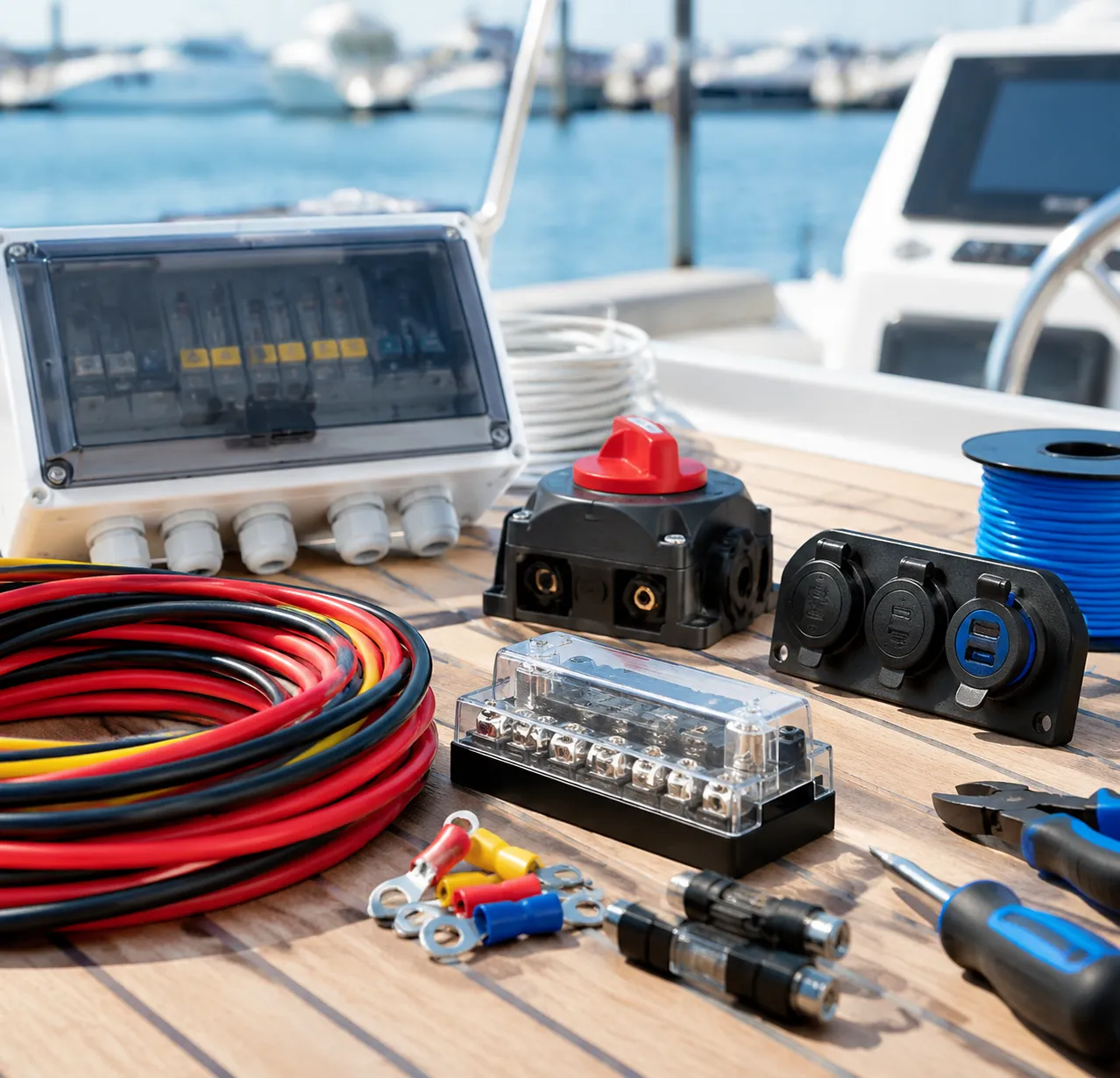
| Checklist Item | What We Look For | Key Benefit |
|---|---|---|
| Marine-Grade Construction | Tinned copper conductors, UV-resistant insulation, IP67+ waterproof seals | Prevents saltwater corrosion and vibration fatigue |
| Standards Compliance | Verified ABYC, UL 1426, CE, and USCG certifications | Ensures safety and insurance compliance |
| Comprehensive Inventory | Full stock of cables, breakers, panels, and charging systems | Complete one-stop procurement |
| Clear Warranty & Returns | Multi-year warranty coverage and transparent return terms | Protects investment against early component failure |
| Fulfillment & Support | Rapid dispatch, bulk supply capabilities, and active technical support | Minimizes critical vessel downtime |
1. Verified Marine-Grade, Corrosion-Resistant Product Construction
True marine electrical gear must withstand saltwater spray, heavy humidity, fuel vapors, and constant engine vibration. We ensure every component—from tinned copper wire to marine-grade busbars—uses anti-corrosive alloys and specialized shielding. Sourcing from dedicated vendors ensures compatibility alongside other heavy-duty marine machinery spare parts.
2. Full Compliance with ABYC, UL, and CE Standards
Never compromise on marine safety ratings. Top-tier marine electrical supply distributors supply parts meeting or exceeding ABYC, UL 1426, ISO, and CE specifications. This guarantees correct current-carrying capacity, flame retardancy, and insulation integrity under extreme offshore loads.
3. Extensive Inventory Across All Core Electrical Categories
A qualified supplier must stock the complete ecosystem:
Wiring & Cables: Heavy-duty battery cables, flat multi-conductor wiring, and tinned marine primary wire.
Circuit Protection: Ignition-protected circuit breakers, high-amperage fuses (ANL/Class T), and water-sealed distribution panels.
Power Distribution: Complete marine power distribution systems, isolators, selector switches, and busbars.
4. Transparent Warranty Coverage and Fair Return Policies
Reputable marine equipment vendors back their products with clear, written manufacturer warranties. A supplier that stands firmly behind their switches, inverters, and battery accessories gives you total peace of mind for mission-critical marine applications.
5. Fast Shipping, Responsive Technical Support, and Reliable Bulk Fulfillment
When a vessel needs immediate repairs or a yard requires bulk delivery on a tight build schedule, delivery speed matters. A dependable partner provides same-day dispatch, verified spec sheets, and experienced technical support to confirm wire sizing, load limits, and system compatibility before purchase.
Common Mistakes to Avoid When Choosing Marine Electrical Supply Sources
Finding reliable sources for marine electrical supplies means knowing what red flags to avoid. A single compromised part can cripple a vessel's power distribution or trigger onboard hazards. Here are the critical mistakes we frequently see buyers make when sourcing electrical gear:
Buying Automotive Parts for Marine Use
Standard automotive components are not engineered for damp, salty, or explosive environments. Using auto-grade parts leads to:
Severe galvanic corrosion: Untinned copper rapidly oxidizes in salt air, creating high resistance and voltage drops.
Explosion and spark risks: Automotive switches and alternators lack SAE J1171 ignition protection, posing severe fire risks in enclosed engine spaces.
Insulation breakdown: Non-marine insulation degrades quickly under oil, fuel, and UV exposure.
Ignoring Certification and Material Quality
Cutting corners on standards drastically shortens component lifespan. Choosing untracked, uncertified vendors often means receiving hardware lacking ABYC, UL 1426, or CE compliance. Procuring through established ship supply networks guarantees that cables, terminals, and breakers have passed strict flammability and moisture-resistance testing.
Choosing Lowest Price Over Reliability
Opting for bargain-basement hardware from unverified platforms always introduces hidden costs:
Unscheduled vessel downtime: Premature component failure stalls operations and inflates labor costs.
Catastrophic electrical fires: Substandard copper alloys and cheap plastic housings melt under normal marine operational loads.
The top sources for marine electrical supplies balance fair pricing with strict marine-grade manufacturing standards to keep total cost of ownership low.
Overlooking System Compatibility
Even high-grade parts fail when integrated into an incompatible network. Common integration mistakes include:
Mismatched voltages: Installing 12V accessories on 24V or 48V banks without proper step-down converters.
Incorrect wire gauges: Undersizing cables causes thermal stress, severe voltage loss, and tripped breakers.
Incompatible circuit protection: Using thermal breakers where magnetic-hydraulic breakers are required for inductive motor loads.
Where Local Buyers Usually Search for Marine Electrical Supplies
When equipment fails at the dock or during scheduled refits, finding the right source quickly is critical. Depending on urgency, order volume, and technical requirements, buyers tap into four main sourcing channels to secure reliable sources for marine electrical supplies.
| Sourcing Channel | Best Use Case | Typical Inventory | Lead Time |
|---|---|---|---|
| Local Marine Chandlers | Urgent fixes, emergency replacements | Fast-moving switches, fuses, basic wire | Immediate (Counter pickup) |
| Regional Distributors | Commercial fleet upkeep, bulk refits | Heavy-gauge tinned cable, busbars, panels | Same-day or next-day delivery |
| Specialized Online Suppliers | System overhauls, spec comparisons | Full catalog, specialty components, DC systems | 1–3 business days |
| Boatyards & Repair Shops | Certified installations, custom wiring | Professional-grade sub-assemblies, OEM parts | On-demand during service |
Nearby Marine Stores and Chandlers
Local chandleries are the front-line option for urgent hands-on inspection and emergency repairs. When an active vessel experiences a blown fuse, a corroded terminal, or a failed bilge pump switch right before departure, picking up parts directly from a physical counter prevents costly delays. While prices per unit are generally higher and specialized stock can be limited, the immediate availability makes them vital for emergency maintenance.
Regional Distributors and Wholesalers
For marine electricians, commercial operators, and boatyards managing ongoing maintenance, regional distributors act as top sources for marine electrical supplies. These vendors offer:
Bulk Volume Pricing: Lower costs on heavy reels of marine-grade tinned wire and battery cables.
Consistent Batch Quality: High-standard components backed by manufacturer safety certifications.
Direct Trade Accounts: Streamlined procurement, invoicing, and scheduled route deliveries.
Online Marine Suppliers with Fast Local Delivery
Specialized digital suppliers bridge the gap between large inventory and rapid turnaround. Online platforms allow project managers to compare electrical datasheets, verify ABYC compliance, and check exact component dimensions before ordering. With strategically located regional warehouses, many online vendors now provide same-day dispatch and overnight local delivery on full marine power distribution systems.
Boatyards, Repair Shops, and Industry Referrals
Vessels undergoing comprehensive electrical refits rely heavily on local boatbuilders and certified marine technicians. Working alongside full-service ship repair facilities ensures access to commercial-grade switchgear, certified battery banks, and custom-engineered wiring harnesses that have been rigorously field-tested in demanding marine environments.
Why Working with a Specialized Marine Supplier Saves Time and Money
Guaranteed Fit for Harsh Saltwater and High-Vibration Environments
Standard commercial electrical components quickly degrade when exposed to salt mist, high humidity, and constant engine vibration. A specialized marine electrical components supplier delivers purpose-built hardware:
True tinned copper conductors that stop corrosion from creeping under insulation.
Ignition-protected housings and sealed enclosures rated to handle continuous pounding and engine-room heat.
UV-stabilized insulators that resist cracking under intense sunlight.
Lower Failure Rates and Fewer Warranty Headaches
Using parts engineered specifically for boats slashes emergency repairs and warranty claims:
Engineered durability: Components operate reliably within high-demand marine power distribution systems, preventing voltage drops and blown fuses.
Compliance assurance: Pre-certified parts meet stringent ABYC and international standards right out of the box.
Reduced downtime: Fewer electrical gremlins mean less time troubleshooting at the dock and more time on the water.
Simplified Reordering, Fleet Standardization, and Long-Term Value
Working directly with top sources for marine electrical supplies streamlines procurement for boatbuilders, fleet operators, and service yards:
| Strategic Advantage | Long-Term Benefit |
|---|---|
| Fleet-Wide Standardization | Uniform panels, breakers, and wiring simplify maintenance across multiple vessels. |
| Streamlined Supply Chains | Direct access to dedicated inventory eliminates part-matching guesswork and delays. |
| Lower Total Cost of Ownership | Higher-quality initial components drastically reduce replacement frequency and labor costs. |
When managing new builds or refit projects, combining verified equipment from a trusted marine equipment vendor with expert shipbuilding construction supervision services ensures every circuit, panel, and cable run meets top-tier marine reliability standards.
Why Choose JUKO MARINE for Marine Electrical Supplies
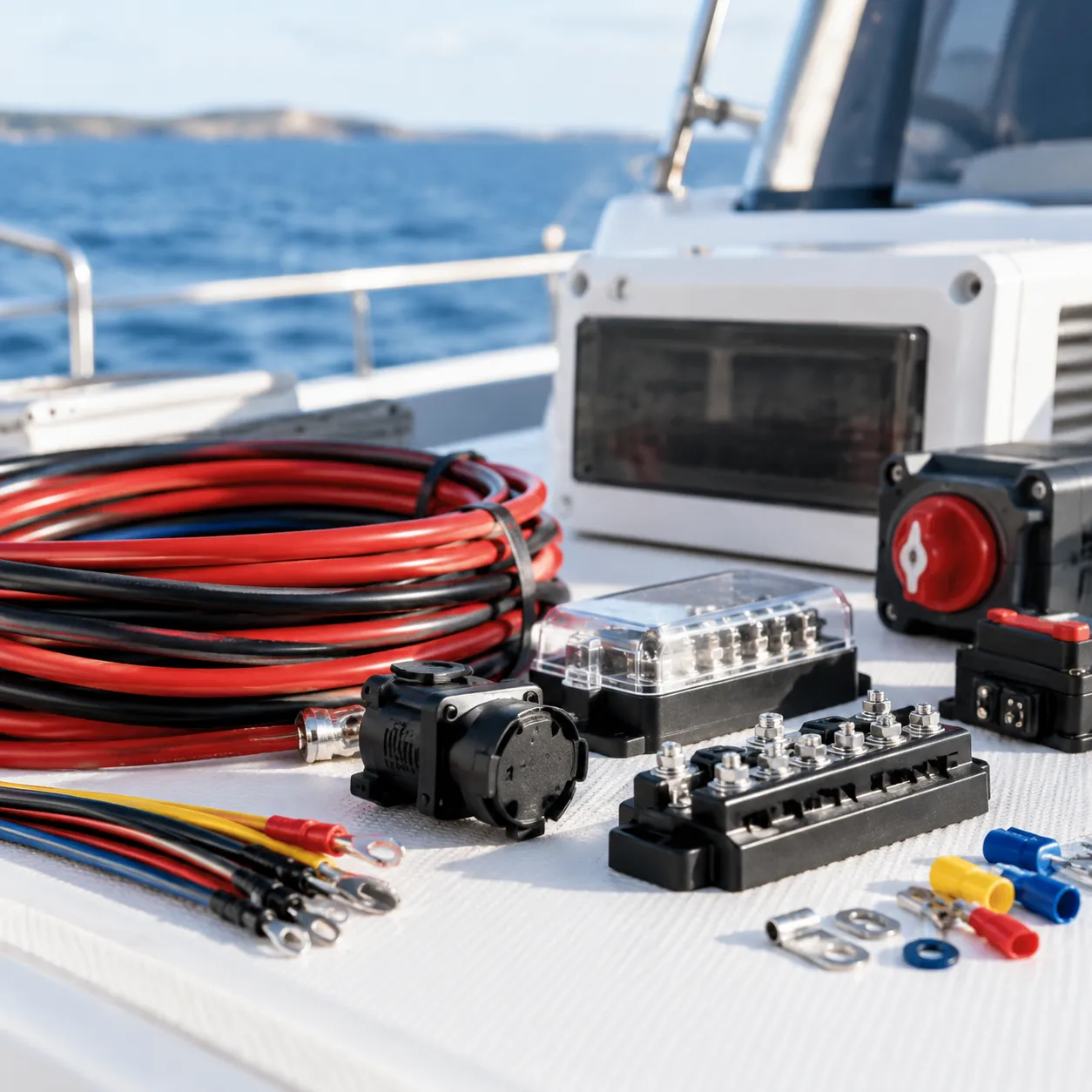
When you need reliable sources for marine electrical supplies, you need a partner that understands the high-stakes reality of marine operations. At JUKO MARINE, we eliminate the guesswork by supplying fully certified, commercial-grade electrical components built specifically to endure extreme saltwater environments, heavy vibration, and continuous thermal cycling.
Dedicated Focus on Professional-Grade Components
We do not cut corners by stocking cross-over automotive parts. Every item in our inventory—from tinned copper cabling to heavy-duty switchboards—is selected to meet strict ABYC, CE, and UL marine safety benchmarks. Whether supporting active vessel operations, refits, or comprehensive newbuilding services, our lineup guarantees complete electrical integrity.
Engineered Durability for Demanding Marine Environments
Salt air, humidity, and mechanical shock destroy subpar electrical systems rapidly. Our marine components feature:
True Marine-Grade Metallurgy: High-purity tinned copper conductors and nickel-plated brass busbars to eliminate galvanic corrosion.
Heavy-Duty Ingress Protection: IP67 and IP68 sealed switchgear, waterproof junction boxes, and adhesive-lined heat shrink terminals.
Vibration-Resistant Assemblies: Secure screw-clamp terminations and flame-retardant, high-temp insulation (rated to 105°C dry / 75°C wet).
| Feature | Standard Commercial Supplies | JUKO MARINE Supplies |
|---|---|---|
| Corrosion Defense | Bare copper / standard plating | Pure tinned copper & marine-grade alloys |
| Vibration Rating | Standard mechanical fit | Marine-certified locking connections |
| Waterproofing | Basic splash resistance | True IP66/IP67/IP68 submersible sealing |
| Compliance | General electrical (UL/NEC) | ABYC, USCG, CE & ISO Marine Standards |
| Technical Support | Basic catalog assistance | Direct engineering & load calculation support |
Comprehensive Lineup and Dependable Support
We serve as one of the top sources for marine electrical supplies by providing end-to-end electrical solutions for boat owners, commercial operators, and shipyards worldwide.
-
- Complete Power Distribution: Marine circuit breakers, battery isolators, high-amp busbars, and distribution panels.
- Wiring & Connection Gear: Multi-conductor marine cables, battery cables, and heat-shrink terminal kits.
- Direct Sourcing & Swift Logistics: Fast turnaround times, verified batch traceability, and expert technical guidance to keep downtime at zero.
Frequently Asked Questions (FAQ)
What makes a supply source truly "marine reliable"?
A dependable boat electrical parts supplier does far more than repackage standard consumer gear. We verify that reliable sources for marine electrical supplies back their entire inventory with recognized industry standards (such as ABYC, UL 1426, ISO, or CE), provide complete engineering datasheets, and maintain consistent stock of genuine tinned copper components. For comprehensive fleet outfitting and commercial builds, our team incorporates these exact verification standards during initial supply pre-operational preparation to ensure long-term vessel reliability.
Are all marine electrical products 100% corrosion-resistant?
No metal is entirely immune indefinitely, but genuine marine components are built specifically to withstand aggressive saltwater atmospheres. Key protective features include:
Individually tinned copper strands that stop galvanic corrosion under the insulation jacket.
316 stainless steel or tinned brass hardware to prevent terminal oxidation.
Adhesive-lined heat shrink and IP67/IP68 enclosures to keep moisture away from bare contact points.
Should I buy marine electrical parts from a local store or an online supplier?
Both channels serve specific operational needs:
Local Chandlers: Ideal for immediate, emergency repair parts or hands-on size checking.
Online Marine Electrical Supply Distributors: Best for scheduled retrofits, full wiring jobs, bulk ordering, and access to complete marine power distribution systems at competitive commercial pricing.
How do I verify if a wire or connector is genuine marine grade?
Check the outer insulation jacket for visible ABYC or UL 1426 markings. Authentic marine wire uses Type III stranding—consisting of ultra-fine, individually electro-tinned copper conductors rather than stiff bare copper. For wiring terminations, always look for seamless, tinned copper barrels with built-in adhesive heat shrink. You can find detailed breakdown guides on component selection in our technical marine articles.
What is the single most critical factor to check before ordering marine electrical parts?
The most critical factor is system compatibility under marine ignition protection standards. Ensure that every circuit breaker, fuse block, and battery selector switch matches your operational amp draw and meets SAE J1171 or ISO 8846 ratings for gasoline or enclosed engine spaces to prevent catastrophic electrical fires.