

Building a new vessel is a multi-million dollar gamble if you rely solely on the shipyard to monitor its own work. Between unexpected delays, missed specs, and cut corners during construction, a single oversight can compromise your asset's performance for decades.
That is why professional ship newbuilding supervision isn't just an option—it is your strongest line of defense.
In this guide, you will learn how end-to-end newbuilding supervision protects your capital investment, holds shipyards accountable from initial plan approvals to final sea trials, and delivers a fully compliant, future-ready vessel on schedule.
Let's dive in!
Shipyard Evaluation and Maker List Selection
We audit potential shipyards to verify that their physical and operational capabilities match your project's technical ambitions.
-
- Yard Capacity & Track Record: We analyze historical delivery performance, berth availability, financial stability, and order book saturation.
- Facility Capabilities: We inspect dry docks, gantry cranes, steel processing workshops, and environmental coating sheds.
- Workforce Quality: We evaluate the technical skill of yard engineers, sub-contractors, and certified welder teams.
- Maker List Selection: We vet key equipment suppliers—from main engines to automation systems—ensuring high reliability and global spare parts availability.
Technical Specification Optimization
Standard yard specifications are written to protect the builder's profit margin, not your operational efficiency. We refine every page of the technical package to align your asset with real-world trade routes.
-
- Operational Alignment: Tailoring speed-consumption profiles, cargo handling gear, and draft parameters to your key commercial routes.
- Engineering Reliability: Upgrading baseline equipment specs to heavy-duty marine standards to prevent premature failure.
- Future Trade Preparation: Factoring in space, weight, and structural margins for future environmental compliance upgrades.
Safeguarding Capital Through Contract Alignment
Our newbuilding supervision strategy embeds enforceable technical milestones and clear oversight rights directly into the shipbuilding contract before signing.
-
- Milestone-Based Payments: Linking progress payments to verified engineering milestones rather than arbitrary calendar dates.
- Performance Penalties: Defining clear liquidated damages for speed shortfalls, deadweight deficits, or fuel overconsumption.
- Unrestricted Site Rights: Securing full site team access to workshops, sub-contractor yards, and early-stage assembly facilities.
Pre-Construction Strategy Framework
| Strategic Focus | Primary Action | Lifecycle Asset Protection |
|---|---|---|
| Yard Selection | Audit facilities, labor quality, and track record | Prevents delivery delays and structural defects |
| Spec Review | Optimize machinery, hull design, and operational profiles | Maximizes fuel efficiency and trading capability |
| Maker List | Limit choices to top-tier, global OEM suppliers | Reduces operational downtime and maintenance costs |
| Contract Alignment | Insert strict technical milestones and penalty clauses | Protects capital expenditure and owner oversight rights |
Plan Approval & Engineering Optimization in Ship Newbuilding Supervision
Before the first steel plate is cut, rigorous maritime plan approval guarantees that design intent aligns perfectly with operational efficiency and safety. In our ship newbuilding supervision practice, we stress-test engineering blueprints early in the design cycle to prevent expensive modifications later at the berth.
Structural & Machinery Blueprint Review
We conduct an exhaustive evaluation across all primary vessel systems before authorizing production drawings:
-
- Hull Structure: Verifying plate thickness, yield stress calculations, and high-stress fatigue zones.
- Machinery Layouts: Optimizing spatial access around main propulsion units, pumps, and auxiliary equipment.
- Electrical Distribution: Auditing single-line diagrams, load balances, and short-circuit protection schemes.
- Piping Networks: Reviewing valve positioning, flow rates, material durability, and anti-corrosion routing.
Regulatory Compliance & 3D Design Optimization
| Focus Area | Engineering Objective | Commercial & Operational Value |
|---|---|---|
| Regulatory Compliance | Align designs with IMO regulations, SOLAS, MARPOL, and Flag State requirements through robust safety and compliance management protocols. | Eliminates registration delays and guarantees immediate trading rights upon delivery. |
| 3D Clash Detection | Resolve spatial bottlenecks, piping overlaps, and cable tray conflicts inside the 3D model. | Eliminates manual rework and structural modifications during block assembly. |
| Energy Efficiency | Optimize hull hydrodynamics, ESD (Energy Saving Devices), propeller profile, and power generation configurations. | Reduces operational fuel consumption, optimizes CII ratings, and lowers emissions. |
Resolving technical clashes in the digital domain protects capital investment, accelerates shipyard production, and secures long-term asset value.
Ship Newbuilding Supervision: On-Site Yard Execution
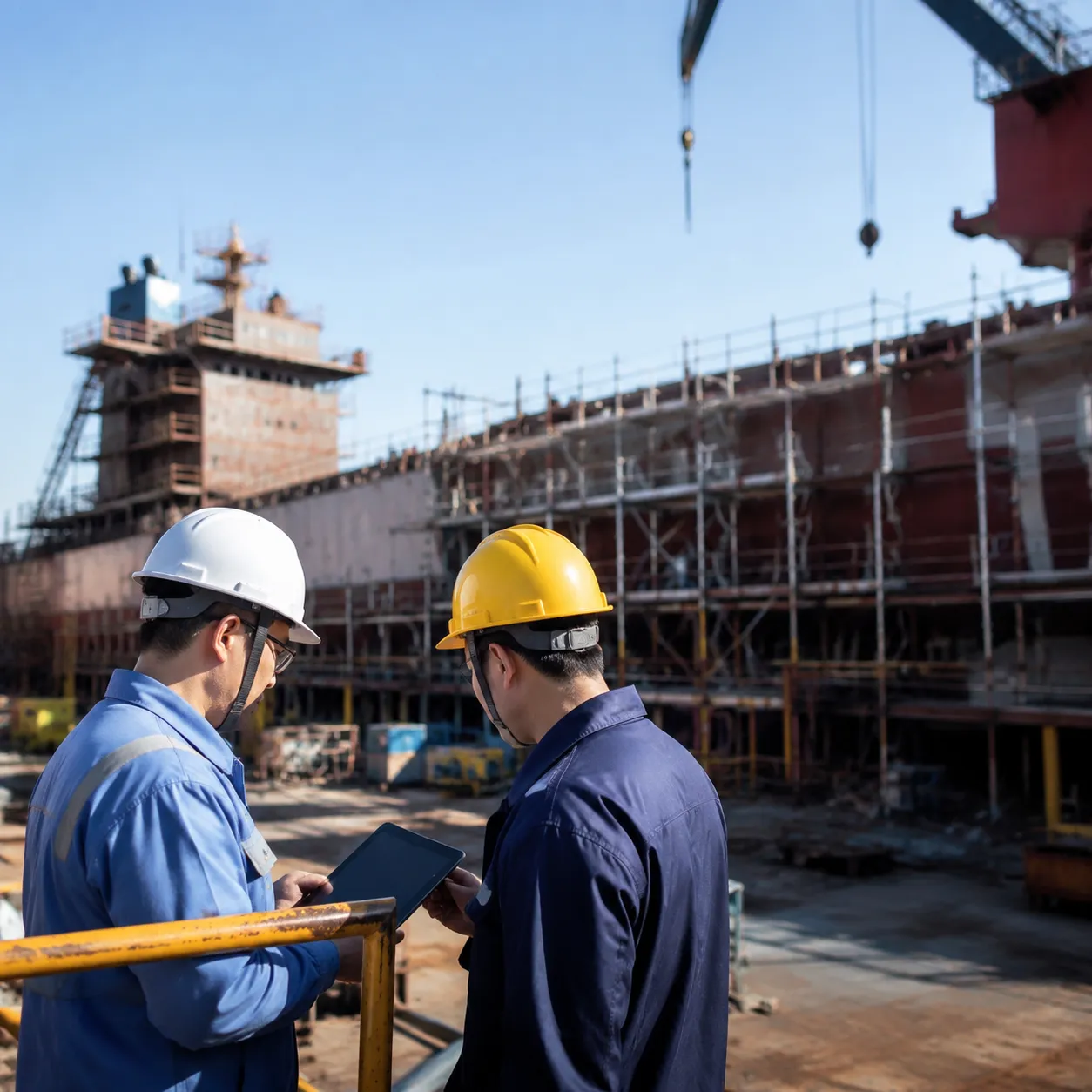
Mobilizing the Shipyard Site Team
We assemble a multi-disciplinary team tailored specifically to your vessel's operational design:
-
- Project Manager: Coordinates site logistics, schedule tracking, and commercial alignment with yard management.
- Hull & Welding Inspectors: Oversee structural alignment, plate fitting, and block jointing.
- Machinery & Electrical Engineers: Monitor engine installations, shaft alignment, power generation, and automation systems.
- Paint & Coating Advisors: Ensure strict environmental and application controls for long-term corrosion prevention.
Steel Cutting, Block Assembly & NDT Inspection
Steel cutting marks the physical start of construction. We monitor material quality, plate preparation, and dimensional accuracy across every block assembly:
-
- Welding Standards: Continuous inspection of both automatic and manual welding operations to prevent distortion.
- NDT Verification: Systematic Non-Destructive Testing (ultrasonic, radiographic, and magnetic particle) to verify structural integrity before block erection.
NACE/FROSIO Coating Supervision
Coatings are your primary defense against aggressive marine corrosion. Our certified inspectors enforce NACE/FROSIO coating supervision throughout grit blasting, surface profiling, and paint application. We maintain strict quality and compliance standards to ensure correct dry film thickness (DFT) and climate-controlled curing for anti-fouling systems.
Machinery Outfitting & System Installation
Precise mechanical installation eliminates operational vibration and early wear:
-
- Engine & Shafting: Overseeing main engine bedplate alignment, chocking, and laser-guided shaft line alignment.
- Auxiliary Systems: Validating generator seatings, piping runs, pressure testing, and cable tray routing across all decks.
Digital Non-Conformance Reporting (NCR)
Unresolved defects on the berth lead to delivery bottlenecks. As part of our comprehensive ship newbuilding supervision services, we implement a transparent, digital NCR tracking system. Every defect is logged with photo evidence, categorized by severity, and tracked until official shipyard rectification and re-inspection.
| On-Site Supervision Focus | Primary Quality Control Actions | Key Outcome |
|---|---|---|
| Structural Integrity | Plate fit-up, block assembly, NDT weld checks | Eliminates structural failures and rework |
| Coating Systems | Blast profile, humidity checks, DFT measurement | Maximizes hull life and anti-fouling efficiency |
| Machinery Outfitting | Shaft alignment, piping pressure tests, line checks | Prevents mechanical failure and excessive vibration |
| Defect Management | Digital NCR logging, real-time shipyard tracking | Ensures full compliance before launch |
Phase 4: Ship Newbuilding Supervision for Testing, Commissioning, and Handover

Is your vessel truly ocean-ready, or are hidden yard defects waiting to surface on her maiden voyage? The commissioning phase converts thousands of tons of steel into a fully functional asset. As part of our comprehensive ship newbuilding supervision, our site team strictly monitors every test from factory floors to open ocean trials, ensuring performance guarantees are fully validated before capital changes hands.
Factory Acceptance Tests (FAT)
Equipment integrity verification begins long before components arrive at the shipyard berth. Our shipbuilding project management protocol mandates rigorous Factory Acceptance Tests (FAT) directly at original equipment manufacturer (OEM) facilities.
-
- Engine & Power Validation: We witness full-load shop testing for main propulsion engines, auxiliary generator engines, and heavy-duty compressors prior to dispatch.
- Automation & Control Systems: Control panels, safety alarms, and emergency shutdown logic undergo testing in simulated operational environments.
- Component Quality Audit: Verifying that all critical machinery and certified marine spare parts and equipment conform to approved drawings and class standards before shipment.
Harbor Acceptance Tests (HAT)
Once machinery is mounted on seatings and systems are connected, our newbuilding site team oversees Harbor Acceptance Tests (HAT) to verify quay-side performance.
| System Category | Key HAT Verification Metrics | Focus Areas |
|---|---|---|
| Power Distribution | Switchboard synchronization, load sharing, preferential trips | Electrical safety & system redundancy |
| Piping & Auxiliary | Pressure testing, ballast pump capacities, bilge alarms | Hydrostatic integrity & fluid flow |
| Safety & Automation | Fire detection systems, emergency generator auto-start | SOLAS compliance & emergency response |
Sea Trials Execution & Performance Proving
Sea trials and commissioning represent the final test of hull dynamics, propulsion output, and navigational safety. Our superintendents lead operations under real sea conditions to prove contractual compliance.
-
- Speed & Endurance Runs: Running the engine at Maximum Continuous Rating (MCR) to verify speed, structural vibration, sound levels, and specific fuel oil consumption (SFOC).
- Maneuverability Drills: Executing turning circle tests, Zig-Zag maneuvers, and crash-stop drills to measure steering performance and stopping distances.
- Blackout Recovery: Intentionally tripping main power distribution circuits at sea to test emergency generator auto-start times and plant restoration.
Punch List Resolution and Protocol of Delivery
The final stage of newbuilding supervision focuses on asset protection, regulatory clearance, and official title transfer.
-
- Outfitting Inspection: Joint walkthroughs across deck spaces, cargo holds, and accommodation quarters to check finish quality and coating condition.
- Class and Flag State Compliance: review of statutory certificates, class notation approvals, and approved operational manuals.
- Defect List Clearance: Logging punch-list non-conformances into an active tracking database and verifying yard rectifications prior to signing off.
- Inventory Handover: Checking that initial spare parts, tools, and necessary one-stop vessel supply packages are onboard and stored according to specifications before signing the Protocol of Delivery and vessel handover.
Post-Delivery & Guarantee Period Support
The process of ship newbuilding supervision extends well beyond the initial vessel handover. During the critical 12-to-24-month operational warranty window, active tracking and technical advocacy ensure the builder honors all contractual commitments while protecting your capital investment.
| Operational Phase | Focus & Execution | Strategic Value |
|---|---|---|
| Guarantee Management | Log, monitor, and categorize operational defects and component failures in real time during the warranty period. | Prevents unbudgeted maintenance costs and enforces builder accountability. |
| Claim Resolution | Prepare detailed engineering documentation to substantiate shipyard-backed warranty claims. | Secures zero-cost OEM replacement parts, specialized technician attendance, and financial recovery. |
| Lifecycle Feedback | Integrate post-delivery operational data directly into ongoing technical management and fleet operations. | Eliminates recurring design flaws and optimizes specifications for future vessel orders. |
Guarantee Claim Management & Fleet Optimization
-
- Rigorous Defect Logging: We implement a standardized defect tracking protocol immediately after delivery, gathering photographic, diagnostic, and sensor data to prove claim legitimacy.
- Relentless Technical Advocacy: We manage direct negotiations with shipyard guarantee engineers and equipment manufacturers, ensuring swift repairs without prolonged operational downtime.
- Data-Driven Feedback Loops: We convert warranty insights and early operational metrics into actionable data, refining future newbuilding supervision strategies and long-term fleet maintenance plans.
Future-Proofing Newbuilds: Decarbonization and Digital Integration
Building a vessel today means preparing for tomorrow's environmental regulations and technological shifts. During ship newbuilding supervision, we focus on integrating flexible propulsion systems, digital architecture, and structural margins to protect your capital investment over a 25-year operational lifespan.
Alternative Fuels & Dual-Fuel Systems
Transitioning to low-carbon fuels requires strict oversight during yard construction. Whether installing dual-fuel engines running on LNG, Methanol, or Ammonia, or integrating battery-hybrid systems, our newbuilding supervision team ensures safe containment, specialized piping, and advanced hazardous area zone compliance. Leveraging technical protocols from our specialized LNG carrier and tanker services, we verify fuel gas supply systems (FGSS) and ventilation arrangements to meet strict safety and operational standards.
-
- LNG & Methanol: Rigorous NDT on cryo-piping, double-walled fuel lines, and bunkering manifolds.
- Ammonia Readiness: Enhanced toxicity mitigation, localized leak detection, and specialized material selection.
- Battery Hybrids: Thermal runaway protection, dedicated cooling circuits, and battery management system (BMS) integration.
Digital Twins & IoT Sensors
Modern ship newbuilding supervision extends into the digital domain. We oversee the installation and calibration of high-density IoT sensor networks and digital twin infrastructure during block assembly and outfitting.
-
- Real-Time Monitoring: Hull stress monitoring, shaft power meters, and fuel consumption sensors wired directly to onboard edge servers.
- Predictive Maintenance: Vibration sensors on primary rotating machinery mapped directly for cloud-based diagnostic platforms.
- Data Verification: Validating signal integrity and cyber-secure data pipelines prior to vessel delivery.
Designing for Future Retrofits
| Future Technology | Pre-Engineered Design Consideration | Supervisory Focus Area |
|---|---|---|
| Wind-Assisted Propulsion | Main deck stiffening & foundation pre-wiring | Structural NDT & deck reinforcement checks |
| Carbon Capture Systems (CCS) | Space allocation in funnel casing & power reserve | Weight distribution & high-pressure piping margins |
| Alternative Fuel Tanks | Modular void space design & boundary preparation | Hazardous zone isolation & tank coating supervision |
Reserving structural allowances and auxiliary power capacity during construction guarantees low-cost retrofits as new green technologies mature, keeping your fleet commercially competitive.